

Illustration of King David weeping over the death of his son Absalom who was killed in battle. Image source unknown – appears to be AI generated.
by Brian Shilhavy
Last week I released the Second Edition of my eBook, The Concept of the American Christian Family is a Myth and is NOT Found Anywhere in the Bible.
One of the chapters of this book, which can also be read as a single article here [1], is titled The Concept of the American Christian Family is a Myth and is NOT Found Anywhere in the Bible (The title of the book is from this chapter).
In this chapter I show how the “perfect Christian family” does not exist anywhere in the pages of the Bible, as even all the “heroes of the faith” had very difficult and troubled families which today would probably be called “broken families” because they did not meet the standards of today’s Judeo/Christian values for families in Western Culture.
One of those families in the Old Testament that we have quite a bit of text on is the family of King David.
King David fathered many children from many different wives, and one of his children, his son Absalom, completely betrayed him and almost overthrew David from his throne, temporarily taking over the city of Jerusalem.
In the end the people in David’s household who remained loyal to him prevailed, and defeated Absalom in a very bloody battle.
And yet even with this victory, David very nearly lost the entire kingdom, because he idolized Absalom in his heart as his biological son, by loving him more than he loved God.
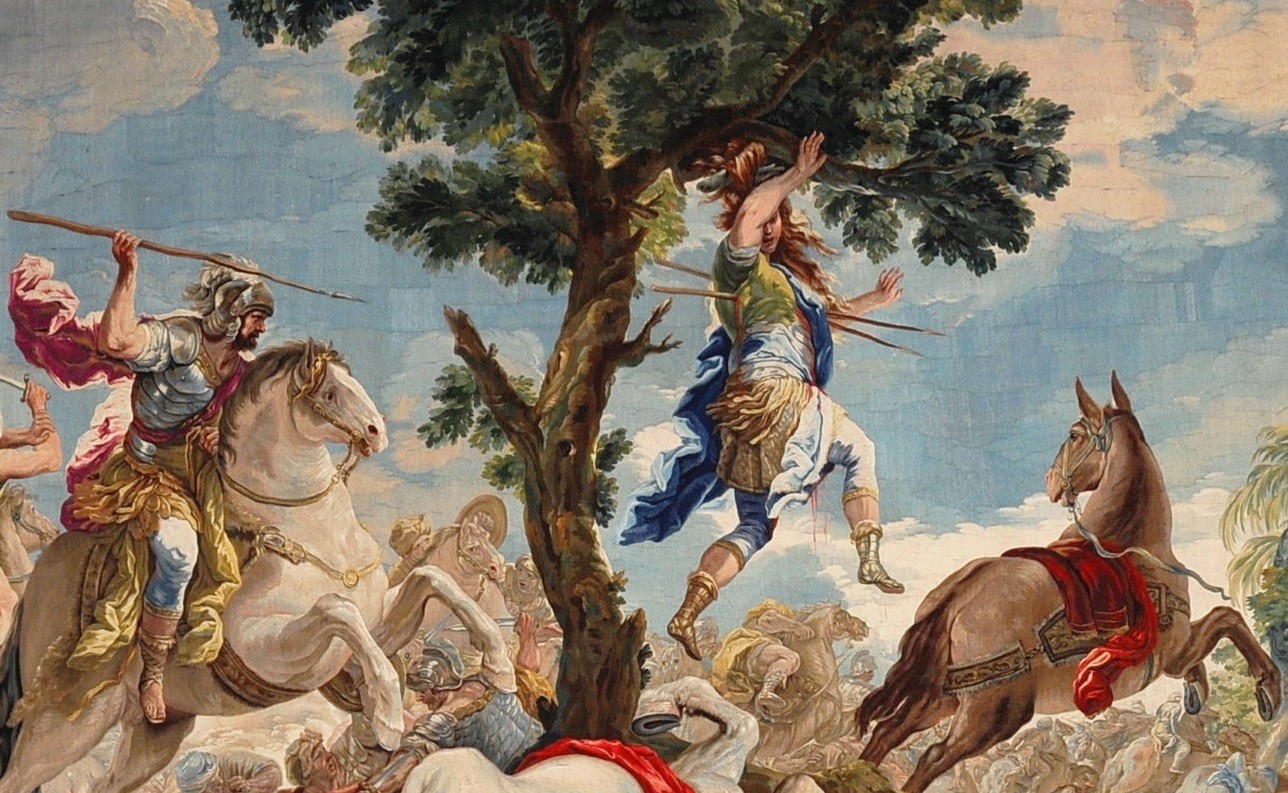
Death of Absalom by Corrado Giaquinto, 1762. Source [2].
.jpg)
David’s Failure as a Father and Not Disciplining his Son for Committing Rape had Disastrous Consequences
The story of Absalom’s betrayal against his father and nearly taking over the Kingdom of Israel, starts with one of King David’s other sons who raped the sister of Absalom, and was never punished for it.
The story is recorded in the Bible in 2 Samuel chapter 13.
In the course of time, Amnon son of David fell in love with Tamar, the beautiful sister of Absalom son of David.
Amnon became frustrated to the point of illness on account of his sister Tamar, for she was a virgin, and it seemed impossible for him to do anything to her.
Now Amnon had a friend named Jonadab son of Shimeah, David’s brother. Jonadab was a very shrewd man. He asked Amnon,
“Why do you, the king’s son, look so haggard morning after morning? Won’t you tell me?”
Amnon said to him,
“I’m in love with Tamar, my brother Absalom’s sister.”
“Go to bed and pretend to be ill,” Jonadab said.
“When your father comes to see you, say to him, ‘I would like my sister Tamar to come and give me something to eat. Let her prepare the food in my sight so I may watch her and then eat it from her hand.'”
So Amnon lay down and pretended to be ill.
When the king came to see him, Amnon said to him,
“I would like my sister Tamar to come and make some special bread in my sight, so I may eat from her hand.”
David sent word to Tamar at the palace:
“Go to the house of your brother Amnon and prepare some food for him.”
So Tamar went to the house of her brother Amnon, who was lying down. She took some dough, kneaded it, made the bread in his sight and baked it. Then she took the pan and served him the bread, but he refused to eat.
“Send everyone out of here,” Amnon said.
So everyone left him. Then Amnon said to Tamar,
“Bring the food here into my bedroom so I may eat from your hand.”
And Tamar took the bread she had prepared and brought it to her brother Amnon in his bedroom.
But when she took it to him to eat, he grabbed her and said,
“Come to bed with me, my sister.”
“Don’t, my brother!” she said to him.
“Don’t force me. Such a thing should not be done in Israel! Don’t do this wicked thing. What about me? Where could I get rid of my disgrace?
And what about you? You would be like one of the wicked fools in Israel. Please speak to the king; he will not keep me from being married to you.”
But he refused to listen to her, and since he was stronger than she, he raped her.
Then Amnon hated her with intense hatred. In fact, he hated her more than he had loved her.
Amnon said to her,
“Get up and get out!”
“No!” she said to him.
“Sending me away would be a greater wrong than what you have already done to me.”
But he refused to listen to her. He called his personal servant and said,
“Get this woman out of here and bolt the door after her.”
So his servant put her out and bolted the door after her. She was wearing a richly ornamented robe, for this was the kind of garment the virgin daughters of the king wore.
Tamar put ashes on her head and tore the ornamented robe she was wearing. She put her hand on her head and went away, weeping aloud as she went.
Her brother Absalom said to her,
“Has that Amnon, your brother, been with you? Be quiet now, my sister; he is your brother. Don’t take this thing to heart.”
And Tamar lived in her brother Absalom’s house, a desolate woman.
When King David heard all this, he was furious.
Absalom never said a word to Amnon, either good or bad; he hated Amnon because he had disgraced his sister Tamar. (2 Samuel 13:1-22)
While the text states that King David was “furious” over the rape, no legal action or punishment was apparently ever started as would be required by the Law of Moses for raping a virgin.
David clearly gave preferential treatment to his own biological children that he probably would not have given to non-family members in the Kingdom of Israel.
This allowed the anger and spirit of revenge to foster in Absalom for two years.
Two years later, when Absalom’s sheepshearers were at Baal Hazor near the border of Ephraim, he invited all the king’s sons to come there.
Absalom went to the king and said,
“Your servant has had shearers come. Will the king and his officials please join me?”
“No, my son,” the king replied.
“All of us should not go; we would only be a burden to you.”
Although Absalom urged him, he still refused to go, but gave him his blessing.
Then Absalom said,
“If not, please let my brother Amnon come with us.”
The king asked him, “Why should he go with you?”
But Absalom urged him, so he sent with him Amnon and the rest of the king’s sons.
Absalom ordered his men,
“Listen! When Amnon is in high spirits from drinking wine and I say to you, ‘Strike Amnon down,’ then kill him. Don’t be afraid. Have not I given you this order? Be strong and brave.”
So Absalom’s men did to Amnon what Absalom had ordered.
Then all the king’s sons got up, mounted their mules and fled.
While they were on their way, the report came to David:
“Absalom has struck down all the king’s sons; not one of them is left.”
The king stood up, tore his clothes and lay down on the ground; and all his servants stood by with their clothes torn.
But Jonadab son of Shimeah, David’s brother, said,
“My lord should not think that they killed all the princes; only Amnon is dead. This has been Absalom’s expressed intention ever since the day Amnon raped his sister Tamar. My lord the king should not be concerned about the report that all the king’s sons are dead. Only Amnon is dead.”
(2 Samuel 13:23-33)
Absalom lived as a refugee for three years after this, staying away from his father and Jerusalem.
When he finally came back to Jerusalem, he began his conspiracy to kill his father and take over his throne, by slandering his father and gathering together his enemies.
In the course of time, Absalom provided himself with a chariot and horses and with fifty men to run ahead of him. He would get up early and stand by the side of the road leading to the city gate.
Whenever anyone came with a complaint to be placed before the king for a decision, Absalom would call out to him,
“What town are you from?”
He would answer,
“Your servant is from one of the tribes of Israel.”
Then Absalom would say to him,
“Look, your claims are valid and proper, but there is no representative of the king to hear you.”
And Absalom would add,
“If only I were appointed judge in the land! Then everyone who has a complaint or case could come to me and I would see that he gets justice.”
Also, whenever anyone approached him to bow down before him, Absalom would reach out his hand, take hold of him and kiss him.
Absalom behaved in this way toward all the Israelites who came to the king asking for justice, and so he stole the hearts of the men of Israel.
At the end of four years, Absalom said to the king,
“Let me go to Hebron and fulfill a vow I made to the LORD. While your servant was living at Geshur in Aram, I made this vow: ‘If the LORD takes me back to Jerusalem, I will worship the LORD in Hebron.'”
The king said to him,
“Go in peace.”
So he went to Hebron.
Then Absalom sent secret messengers throughout the tribes of Israel to say,
“As soon as you hear the sound of the trumpets, then say, ‘Absalom is king in Hebron.'”
Two hundred men from Jerusalem had accompanied Absalom. They had been invited as guests and went quite innocently, knowing nothing about the matter.
While Absalom was offering sacrifices, he also sent for Ahithophel the Gilonite, David’s counselor, to come from Giloh, his hometown.
And so the conspiracy gained strength, and Absalom’s following kept on increasing. (2 Samuel 15:1-12)
It is important to note that before all these things happened to King David, God made a Covenant with David, promising him that he would never lack a descendant to sit on his throne and rule Israel. This promise was about the coming Messiah, Jesus Christ, who was a descendant of David.
This is recorded in 2 Samuel chapter 7.
“Now then, tell my servant David, ‘This is what the LORD Almighty says:
I took you from the pasture and from following the flock to be ruler over my people Israel. I have been with you wherever you have gone, and I have cut off all your enemies from before you.
Now I will make your name great, like the names of the greatest men of the earth. And I will provide a place for my people Israel and will plant them so that they can have a home of their own and no longer be disturbed.
Wicked people will not oppress them anymore, as they did at the beginning and have done ever since the time I appointed leaders over my people Israel.
I will also give you rest from all your enemies.
The LORD declares to you that the LORD himself will establish a house for you: When your days are over and you rest with your fathers, I will raise up your offspring to succeed you, who will come from your own body, and I will establish his kingdom.
He is the one who will build a house for my Name, and I will establish the throne of his kingdom forever. I will be his father, and he will be my son.
When he does wrong, I will punish him with the rod of men, with floggings inflicted by men. But my love will never be taken away from him, as I took it away from Saul, whom I removed from before you.
Your house and your kingdom will endure forever before me; your throne will be established forever.'” (2 Samuel 7:8-16)
The person from David’s family line that would be next to take the throne was not Absalom. While it is recorded in 2 Samuel 14:27 that Absalom fathered three sons and a daughter, his sons apparently died, according to 2 Samuel 18:
During his lifetime Absalom had taken a pillar and erected it in the King’s Valley as a monument to himself, for he thought, “I have no son to carry on the memory of my name.”
He named the pillar after himself, and it is called Absalom’s Monument to this day. (2 Samuel 18:18)
David’s other son, Solomon, who was born to the woman David originally committed adultery with, Bathsheba, was the one who became the next King after David died. David had also murdered Bathsheba’s first husband, Uriah.
What the Old Testament Scriptures actually teach, therefore, is that God uses imperfect families to accomplish his purpose on earth.
Not only is Bathsheba in the family line of the Messiah, Jesus Christ, so is a non-Israelite, the prostitute of Rahab from Jericho:
A record of the genealogy of Jesus Christ the son of David, the son of Abraham: Abraham was the father of Isaac, Isaac the father of Jacob, Jacob the father of Judah and his brothers, Judah the father of Perez and Zerah, whose mother was Tamar, Perez the father of Hezron, Hezron the father of Ram, Ram the father of Amminadab, Amminadab the father of Nahshon, Nahshon the father of Salmon, Salmon the father of Boaz, whose mother was Rahab, Boaz the father of Obed, whose mother was Ruth, Obed the father of Jesse, and Jesse the father of King David.
David was the father of Solomon, whose mother had been Uriah’s wife… (Matthew 1:1-6)
David and those loyal to him had to flee Jerusalem before they were all murdered by Absalom, and after regrouping their forces, they met with the forces loyal to Absalom in battle, and Absalom himself was killed along with about 20,000 other Israelites.
David mustered the men who were with him and appointed over them commanders of thousands and commanders of hundreds. David sent the troops out—a third under the command of Joab, a third under Joab’s brother Abishai son of Zeruiah, and a third under Ittai the Gittite.
The king told the troops,
“I myself will surely march out with you.”
But the men said,
“You must not go out; if we are forced to flee, they won’t care about us. Even if half of us die, they won’t care; but you are worth ten thousand of us. It would be better now for you to give us support from the city.”
The king answered,
“I will do whatever seems best to you.”
So the king stood beside the gate while all the men marched out in units of hundreds and of thousands. The king commanded Joab, Abishai and Ittai,
“Be gentle with the young man Absalom for my sake.”
And all the troops heard the king giving orders concerning Absalom to each of the commanders.
The army marched into the field to fight Israel, and the battle took place in the forest of Ephraim. There the army of Israel was defeated by David’s men, and the casualties that day were great—twenty thousand men.
The battle spread out over the whole countryside, and the forest claimed more lives that day than the sword.
Now Absalom happened to meet David’s men. He was riding his mule, and as the mule went under the thick branches of a large oak, Absalom’s head got caught in the tree.
He was left hanging in midair, while the mule he was riding kept on going. When one of the men saw this, he told Joab,
“I just saw Absalom hanging in an oak tree.”
Joab said to the man who had told him this,
“What! You saw him? Why didn’t you strike him to the ground right there? Then I would have had to give you ten shekels of silver and a warrior’s belt.”
But the man replied,
“Even if a thousand shekels were weighed out into my hands, I would not lift my hand against the king’s son. In our hearing the king commanded you and Abishai and Ittai, ‘Protect the young man Absalom for my sake.’ And if I had put my life in jeopardy—and nothing is hidden from the king—you would have kept your distance from me.”
Joab said,
“I’m not going to wait like this for you.”
So he took three javelins in his hand and plunged them into Absalom’s heart while Absalom was still alive in the oak tree. And ten of Joab’s armor-bearers surrounded Absalom, struck him and killed him.
Then Joab sounded the trumpet, and the troops stopped pursuing Israel, for Joab halted them. They took Absalom, threw him into a big pit in the forest and piled up a large heap of rocks over him.
Meanwhile, all the Israelites fled to their homes. (2 Samuel 18:1-17)
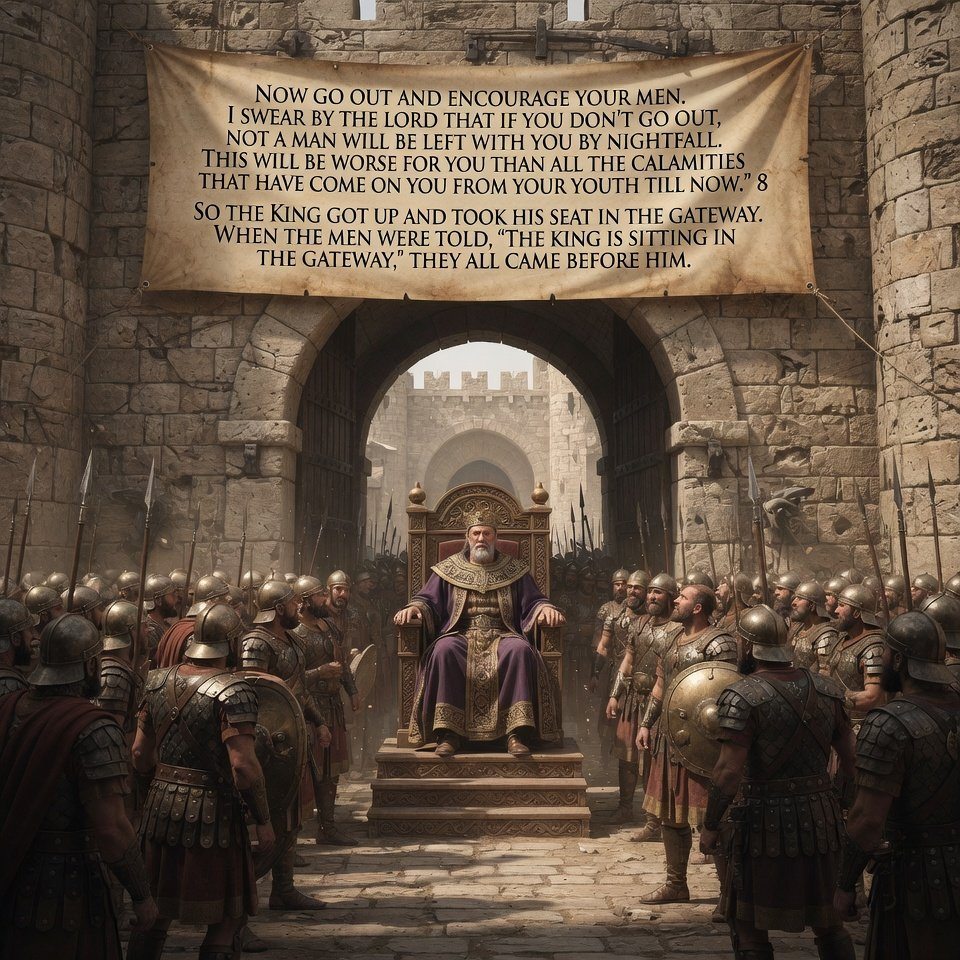
Image source unknown. Appears to be AI generated.
Joab, the head of David’s military, and the only one who was powerful enough to defy the king’s orders, did what he had to do to protect the Kingdom.
He knew full well what David’s response would be, but he also knew full well what the consequences would be if Absalom was allowed to live, so he acted in the best interests of the Kingdom.
What happened next was an event that if David had made the wrong choice, he would have lost everything.
Joab was told,
“The king is weeping and mourning for Absalom.”
And for the whole army the victory that day was turned into mourning, because on that day the troops heard it said,
“The king is grieving for his son.”
The men stole into the city that day as men steal in who are ashamed when they flee from battle. The king covered his face and cried aloud,
“O my son Absalom! O Absalom, my son, my son!”
Then Joab went into the house to the king and said,
“Today you have humiliated all your men, who have just saved your life and the lives of your sons and daughters and the lives of your wives and concubines.
You love those who hate you and hate those who love you. You have made it clear today that the commanders and their men mean nothing to you.
I see that you would be pleased if Absalom were alive today and all of us were dead.
Now go out and encourage your men.
I swear by the LORD that if you don’t go out, not a man will be left with you by nightfall.
This will be worse for you than all the calamities that have come upon you from your youth till now.”
So the king got up and took his seat in the gateway.
When the men were told, “The king is sitting in the gateway,” they all came before him. Meanwhile, the Israelites had fled to their homes. (2 Samuel 19:1-8)
David came within hours of losing everything, simply because he loved his biological son more than he loved God, and the Kingdom of God of which he was appointed King.
If you put your Loyalty to Jesus and the Father Above your Loyalty to Family, the World will Hate You
Loyalty to family members and bloodlines above all else is Satanic and worldly. Jesus made this very clear during his time on earth, stating to the Jews that their bloodlines back to Abraham were meaningless, unless they actually knew God, and recognized that he came from God and was the Messiah.
Jesus also clearly demanded loyalty to him above our loyalty to family members, and he himself was persecuted by his own family members as I have recently written. See:
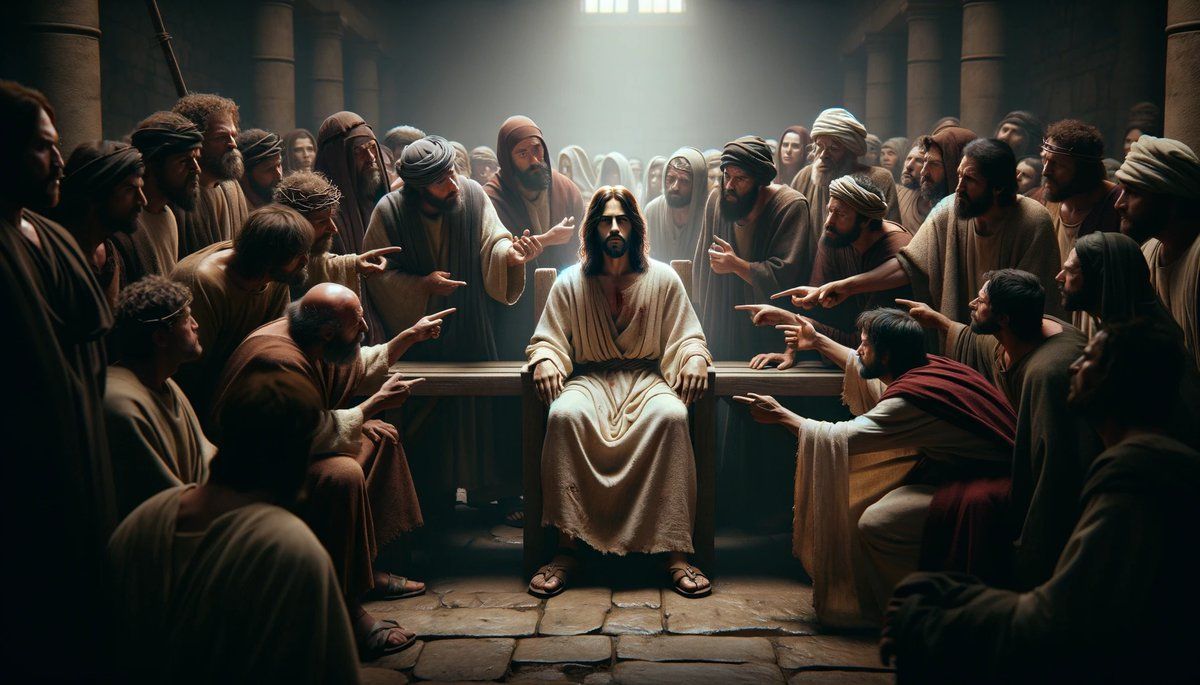 [3]
[3]
When Jesus’s Own Family Turned Against Him [3]
As a result of Jesus’s loyalty to his Heavenly Father above his earthly family, the world hated him. And he stated that the world would hate us also if we walked this same path.
If the world hates you, keep in mind that it hated me first.
If you belonged to the world, it would love you as its own.
As it is, you do not belong to the world, but I have chosen you out of the world. That is why the world hates you.
Remember the words I spoke to you: ‘No servant is greater than his master.’
If they persecuted me, they will persecute you also. If they obeyed my teaching, they will obey yours also. (John 15:18-20)
This principle applies not only to our own biological families, but also to the fake believers in the “Household of God”, or those who claim to be part of “God’s family.”
Being part of a group of believers does not give anyone a “free pass” if they do not know God, and are betraying the faith.
Paul made this very clear in his writings:
It is actually reported that there is sexual immorality among you, and of a kind that does not occur even among pagans: A man has his father’s wife.
And you are proud! Shouldn’t you rather have been filled with grief and have put out of your fellowship the man who did this?
Even though I am not physically present, I am with you in spirit. And I have already passed judgment on the one who did this, just as if I were present.
When you are assembled in the name of our Lord Jesus and I am with you in spirit, and the power of our Lord Jesus is present, hand this man over to Satan, so that the sinful nature may be destroyed and his spirit saved on the day of the Lord. (1 Corinthians 5:1-5)
Timothy, my son, I give you this instruction in keeping with the prophecies once made about you, so that by following them you may fight the good fight, holding on to faith and a good conscience.
Some have rejected these and so have shipwrecked their faith. Among them are Hymenaeus and Alexander, whom I have handed over to Satan to be taught not to blaspheme. (1 Timothy 1:18-20)
It is often a very lonely journey as we walk through this life as aliens and pilgrims, knowing that this is not our home, as we reject the ways of the world and then suffer for it, often by being rejected by our own families or so called “believers” and “brothers”.
But it is worth it, knowing where our loyalties lie, just like the true believers who walked that same lonely path before us!
All these people were still living by faith when they died. They did not receive the things promised; they only saw them and welcomed them from a distance.
And they admitted that they were aliens and strangers on earth.
People who say such things show that they are looking for a country of their own. If they had been thinking of the country they had left, they would have had opportunity to return. Instead, they were longing for a better country—a heavenly one.
Therefore God is not ashamed to be called their God, for he has prepared a city for them.
I do not have time to tell about Gideon, Barak, Samson, Jephthah, David, Samuel and the prophets, who through faith conquered kingdoms, administered justice, and gained what was promised; who shut the mouths of lions, quenched the fury of the flames, and escaped the edge of the sword; whose weakness was turned to strength; and who became powerful in battle and routed foreign armies.
Women received back their dead, raised to life again. Others were tortured and refused to be released, so that they might gain a better resurrection. Some faced jeers and flogging, while still others were chained and put in prison.
They were stoned; they were sawed in two; they were put to death by the sword. They went about in sheepskins and goatskins, destitute, persecuted and mistreated:
The world was not worthy of them.
(Hebrews 11)