





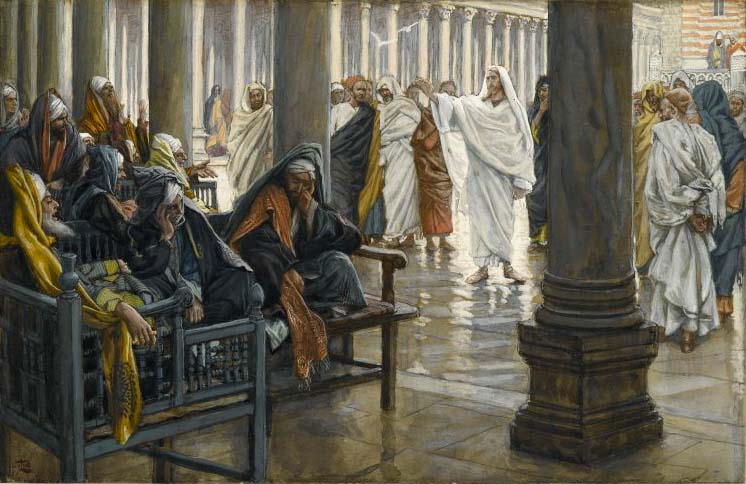
Woe unto You, Scribes and Pharisees – by James Tissot 1886
Source: Wikimedia
Jesus’ authority to heal and his healthcare plan should be a threat to the world’s health authorities and their medical care system. But is it?
The subject of “authority” and health is one that affects every living person on the planet today, and everyone reading this article. Here in the 21st Century, various government agencies regulate “health” and operate under laws and regulations as to just who has the authority to practice healing. This would include the World Health Organization (WHO) internationally, and the Food and Drug Administration (FDA) in the United States.
“Health” of course is generally defined today as “practicing medicine,” and the authority given by government to “practice medicine” is tightly controlled through government licensing. Someone not licensed, or using unapproved products for healing, face arrest and imprisonment.
A similar situation existed during the First Century. Jesus and his disciples did not follow the laws set forth by the government body of their day, and their system of healing was far superior.
As the following story recorded in the Bible’s book of Acts shows, healing people outside of the legal health authorities resulted in arrest:
They seized Peter and John, and because it was evening, they put them in jail until the next day. But many who heard the message believed, and the number of men grew to about five thousand.
The next day the rulers, elders and teachers of the law met in Jerusalem. Annas the high priest was there, and so were Caiaphas, John, Alexander and the other men of the high priest’s family. They had Peter and John brought before them and began to question them: “By what power or what name did you do this?”
Then Peter, filled with the Holy Spirit, said to them: “Rulers and elders of the people! If we are being called to account today for an act of kindness shown to a cripple and are asked how he was healed, then know this, you and all the people of Israel: It is by the name of Jesus Christ of Nazareth, whom you crucified but whom God raised from the dead, that this man stands before you healed. He is “‘the stone you builders rejected, which has become the capstone.’ Salvation is found in no one else, for there is no other name under heaven given to men by which we must be saved.”
When they saw the courage of Peter and John and realized that they were unschooled, ordinary men, they were astonished and they took note that these men had been with Jesus.
But since they could see the man who had been healed standing there with them, there was nothing they could say.
So they ordered them to withdraw from the Sanhedrin and then conferred together.
“What are we going to do with these men?” they asked. “Everybody living in Jerusalem knows they have done an outstanding miracle, and we cannot deny it. But to stop this thing from spreading any further among the people, we must warn these men to speak no longer to anyone in this name.”
Then they called them in again and commanded them not to speak or teach at all in the name of Jesus.
But Peter and John replied, “Judge for yourselves whether it is right in God’s sight to obey you rather than God. For we cannot help speaking about what we have seen and heard.”
After further threats they let them go. They could not decide how to punish them, because all the people were praising God for what had happened. For the man who was miraculously healed was over forty years old. (Act 4:3-22)
Jesus’ Conflict with the Health Authorities
Jesus was the most revolutionary person to ever walk on earth. The claims he made in regard to himself were a direct threat to the Jewish authorities. The ruling class that had power over the people during his day was a group of highly educated religious leaders.
But Jesus was a common man, the son of a carpenter who had no formal religious training. Few seemed to know about his miraculous birth, or that his birthplace was Bethlehem, the city of David, and the place where the Messiah was to come from, according to Old Testament prophecies.
So when Jesus began his public ministry, he seemingly just appeared out of obscurity. He came from a town called Nazareth which was not considered a significant town. Jesus claimed that he was the Son of God and the fulfillment of prophecies regarding the Messiah, the Jewish King who was to come from the family of David and lead the Jewish people.
So how did this common man with no formal education and seemingly no royal heritage become so popular among the people that he very quickly became a threat to the ruling authorities?
It was primarily through his miracles, most of them miracles of healing. His miraculous life validated his teaching and claims as to who he was. Jesus taught with great authority, and he backed up what he taught by casting out demons and healing people, and in some cases even raising dead people back to life.
This was a huge threat to the ruling party for a variety of reasons. The most obvious threat, of course, was that people were claiming that he was the Messiah, the rightful heir to the throne of David. So the ruling party looked for ways to discredit Jesus both in his actions and in his words.
Some of the ruling party were Sadducees, and did not believe in the resurrection of the body. So when Jesus raised people back to life (particularly Lazarus who was quite well-known in the capital city of Jerusalem), it was a direct attack on their teaching and authority.
The most prevalent threat against their authority, however, was probably the authority to heal and declare people “well” or “cured.” This authority was given to the priests under the law written by Moses.
We see, for example, that when Jesus healed a man with leprosy in Matthew chapter 8, he tells the man not to reveal who healed him, but to go show himself to the priests, who were the only ones allowed by law (see Deuteronomy 24:8 and Leviticus 13-14:32) to declare someone clean and “cured” from leprosy:
A man with leprosy came and knelt before him and said, “Lord, if you are willing, you can make me clean.”
Jesus reached out his hand and touched the man. “I am willing,” he said. “Be clean!”
Immediately he was cured of his leprosy.
Then Jesus said to him, “See that you don’t tell anyone. But go, show yourself to the priest and offer the gift Moses commanded, as a testimony to them.” (Matthew 8:2-4)
Jesus had a three year public ministry, and he avoided confrontations with the Jewish leaders as much as possible until towards the end of his ministry, as his popularity increased, and he knew that his time had come to be executed. He then let his disciples carry on his work under his authority.
The gospel records in the Bible give us some glimpses into these controversies with the religious rulers who were in charge of health care. Apparently they did not work on Saturdays, the Sabbath, so when Jesus performed a healing during the Sabbath, they were especially upset.
First example:
Going on from that place, he went into their synagogue, and a man with a shriveled hand was there.
Looking for a reason to accuse Jesus, they asked him, “Is it lawful to heal on the Sabbath?”
He said to them, “If any of you has a sheep and it falls into a pit on the Sabbath, will you not take hold of it and lift it out? How much more valuable is a man than a sheep! Therefore it is lawful to do good on the Sabbath.”
Then he said to the man, “Stretch out your hand.”
So he stretched it out and it was completely restored, just as sound as the other.
But the Pharisees went out and plotted how they might kill Jesus. Aware of this, Jesus withdrew from that place.
Many followed him, and he healed all their sick, warning them not to tell who he was. (Matthew 12:9-16)
Second example:
On a Sabbath Jesus was teaching in one of the synagogues, and a woman was there who had been crippled by a spirit for eighteen years. She was bent over and could not straighten up at all.
When Jesus saw her, he called her forward and said to her, “Woman, you are set free from your infirmity.”
Then he put his hands on her, and immediately she straightened up and praised God.
Indignant because Jesus had healed on the Sabbath, the synagogue ruler said to the people, “There are six days for work. So come and be healed on those days, not on the Sabbath.”
The Lord answered him, “You hypocrites! Doesn’t each of you on the Sabbath untie his ox or donkey from the stall and lead it out to give it water? Then should not this woman, a daughter of Abraham, whom Satan has kept bound for eighteen long years, be set free on the Sabbath day from what bound her?”
When he said this, all his opponents were humiliated, but the people were delighted with all the wonderful things he was doing. (Luke 13:10-17)
The Jewish leaders and priests who ruled during the time of Jesus apparently were not all that effective in healing people. The Old Testament law gave specific instructions regarding healing, and the Jewish people were to trust in God alone to heal, and not the pagan doctors of the world.
Healing by Jesus Superior to “Doctors”
As I have written in other articles, it is important to understand how the word “doctor” was used in the ancient biblical language and culture, as it was quite different from how we understand the word “doctor” today in 21st century western culture and medicine.
The concept of a physician dealing only with physical health and sickness was foreign to most ancient cultures, even the Greek culture which was the foundation of empiricism and much of our western cultural values of academia and “science.” The Greeks called upon their gods to assist with healing, and most “doctors” would have worked in the neighborhood temple rather than a “clinic” or “hospital” as we have today, where the current medical system generally gives no thought to spiritual matters and how they affect health.
The Jews were strictly forbidden to seek out these “doctors” for healing, which would have involved going to pagan temples. The synagogues were the community centers for Jewish teaching, worship, and healing.
We have one story in the gospels of a woman who apparently was not healed by the Jewish priests, and turned to these non-Jewish pagan doctors instead. It is important to understand that such an action by a Jew was a desperate act, as it represented a denial of their faith and risk of being excluded from the religious community centered around the synagogue.
She spent all her money on these pagan doctors and actually got worse. So in desperation she looked for Jesus who had quickly gained a reputation of being a master healer:
And a woman was there who had been subject to bleeding for twelve years. She had suffered a great deal under the care of many doctors and had spent all she had, yet instead of getting better she grew worse.
When she heard about Jesus, she came up behind him in the crowd and touched his cloak, because she thought, “If I just touch his clothes, I will be healed.”
Immediately her bleeding stopped and she felt in her body that she was freed from her suffering.
At once Jesus realized that power had gone out from him. He turned around in the crowd and asked, “Who touched my clothes?”
“You see the people crowding against you,” his disciples answered, “and yet you can ask, ‘Who touched me?'”
But Jesus kept looking around to see who had done it.
Then the woman, knowing what had happened to her, came and fell at his feet and, trembling with fear, told him the whole truth.
He said to her, “Daughter, your faith has healed you. Go in peace and be freed from your suffering.” (Mar 5:25-34)
Jesus’ power and authority to heal was stronger than both the Jewish priests and the pagan doctors. And he constantly demonstrated that power and authority.
In a story told in the Gospel of John, we see an example where a man born blind is healed by Jesus, and then is promptly excluded from the synagogue by the leaders. They even intimidated his parents to testify against him, even though it was obvious that Jesus had performed a great miracle of healing:
They brought to the Pharisees the man who had been blind.
Now the day on which Jesus had made the mud and opened the man’s eyes was a Sabbath. Therefore the Pharisees also asked him how he had received his sight.
“He put mud on my eyes,” the man replied, “and I washed, and now I see.”
Some of the Pharisees said, “This man is not from God, for he does not keep the Sabbath.”
But others asked, “How can a sinner do such miraculous signs?”
So they were divided.
Finally they turned again to the blind man, “What have you to say about him? It was your eyes he opened.”
The man replied, “He is a prophet.”
The Jews still did not believe that he had been blind and had received his sight until they sent for the man’s parents. “Is this your son?” they asked. “Is this the one you say was born blind? How is it that now he can see?”
“We know he is our son,” the parents answered, “and we know he was born blind. But how he can see now, or who opened his eyes, we don’t know. Ask him. He is of age; he will speak for himself.”
His parents said this because they were afraid of the Jews, for already the Jews had decided that anyone who acknowledged that Jesus was the Christ would be put out of the synagogue. That was why his parents said, “He is of age; ask him.” (John 9:13-23)
Jesus’ Authority to Heal Passed on to His Disciples
The threat that Jesus presented to the ruling Jews was just too much for them. People were going to Jesus for healing and believing that he was the Messiah. They were quickly losing their power and control over the people. So when they executed him, they thought their problems were over.
As the passage at the beginning of this article shows, however, their problems were just beginning. The disciples of Jesus were claiming that Jesus had been risen from the dead and was still alive, assuming his position in the Kingdom of God as the true Messiah. His authority to heal was passed on to his followers.
Peter and John healed a lame man right in the temple courts, in plain sight of thousands of people, and they were promptly arrested. They were “unschooled, ordinary men” and certainly did not have the education or authority to perform such healings, especially in the temple!
While the synagogues were the community centers for teaching, worship, and healing, the temple in the capital city of Jerusalem was the Jewish center of worship and teaching for the entire world. Worshipers made pilgrimages to the temple from throughout the entire Roman empire, and beyond.
The High Priest and the Sanhedrin council were the top legal authorities in the nation, and presided in the temple.
So when Peter and John healed this crippled man who had previously been a permanent fixture in the temple courts where he begged for a living, they were immediately arrested and locked up in jail for the evening.
The next day they appeared before all the ruling leaders, the Sanhedrin, the “Spreme Court” of their day. When asked “by what power or what name” they had performed the healing, they replied:
Rulers and elders of the people! If we are being called to account today for an act of kindness shown to a cripple and are asked how he was healed, then know this, you and all the people of Israel: It is by the name of Jesus Christ of Nazareth, whom you crucified but whom God raised from the dead, that this man stands before you healed. He is “the stone you builders rejected, which has become the capstone.”
Salvation is found in no one else, for there is no other name under heaven given to men by which we must be saved. (see above: Act 4:3-22)
This presented quite a dilemma for the rulers, as these men were not following the prescribed health care plan currently in place:
“What are we going to do with these men?” they asked.
“Everybody living in Jerusalem knows they have done an outstanding miracle, and we cannot deny it. But to stop this thing from spreading any further among the people, we must warn these men to speak no longer to anyone in this name.” (see above: Act 4:3-22)
However, Peter and John were now acting under the authority of Jesus, the rightful Messiah who had given them authority to heal under his healthcare plan. Their response:
But Peter and John replied, “Judge for yourselves whether it is right in God’s sight to obey you rather than God. For we cannot help speaking about what we have seen and heard.”
After further threats they let them go. They could not decide how to punish them, because all the people were praising God for what had happened. For the man who was miraculously healed was over forty years old. (see above: Act 4:3-22)
This new healthcare system under the authority of Jesus and administered by his disciples, most of whom were common uneducated people, was becoming very popular. So it is not surprising to read in the book of Acts that many of the priests, the ones who were responsible for administering the healthcare plan under the Law of Moses, became believers in Jesus and started administering the new healthcare plan:
So the word of God spread. The number of disciples in Jerusalem increased rapidly, and a large number of priests became obedient to the faith. (Acts 6:7)
The authority of Jesus is still in place today, as is his healthcare plan. Just as there was during the days and times of Jesus’ earthly life and immediately afterward, there is a competing health care system in place today that denies the authority of Jesus, and would feel threatened if enough people started being healed through Christ’s healthcare plan.
To oppose the authority of today’s medical system and their approved cures is to risk punishment and even imprisonment.
The current healthcare system is not a “healthcare” system at all, but a “medical” system designed to bring great profit to the pharmaceutical companies and others who profit from treating sick people.
If enough people started exercising the authority of Jesus to see cures without having to pay for medical care, it would threaten their business, and opposition would be just as fierce as it was during the days of Jesus and the early disciples.
But will that ever happen?
The Authority to Heal Today
Jesus left his authority to heal with his disciples. After his resurrection and appearances with the disciples, one of the last words uttered by him before his ascension into heaven was:
Then Jesus came to them and said, “All authority in heaven and on earth has been given to me.” (Matthew 28:18)
The apostle James, the brother of Jesus, wrote about the implementation of this new healthcare system, which is still valid today:
Is any one of you sick? He should call the elders of the congregation to pray over him and anoint him with oil in the name of the Lord. And the prayer offered in faith will make the sick person well; the Lord will raise him up. If he has sinned, he will be forgiven. Therefore confess your sins to each other and pray for each other so that you may be healed. The prayer of a righteous man is powerful and effective. (James 5:14-16)
Over the years, this verse has been misinterpreted by some to mean that only prayer should be used in healing. While prayer is the central component here, there is a lot more than just prayer happening in these verses. Let’s take a look at some of the other things besides prayer in these verses.
1. If someone is sick, they should “call the elders of the congregation.”
This statement itself is quite radical in today’s culture. Most people believe that if you are sick you should call the doctor first, the trained professionals. A leader from the “church” might be called later to make a hospital visit, if they are called at all. It is very obvious who our modern day culture believes has the authority and power to heal. But do modern day doctors really heal people? See an article here that answers this question.
2. Anoint with oil.
The common carrier oil would have been olive oil, but aromatic and plant extract oils were very common as well. They would be equivalent to what today are generally referred to as “essential oils.”
These oils were highly valued and had curative properties. They were not regulated or patentable, but available to all who could afford them. Their use in healing sickness was common knowledge, and their use in healing was a knowledge and skill available to anyone who applied themselves to learn such knowledge. (For more information on this subject, see the book “Healing Oils of the Bible”, by David Stewart Ph.D.) See also:
Why Essential Oils Heal and Drugs Don’t
Contrast this with today’s medicines which are highly regulated and cannot be purchased without permission from licensed doctors. They are patented and only available to those who are licensed by the government to dispense them.
While very few plant-based oils are toxic and deaths are extremely rare (and even then only by ingesting, and not “anointing”), side effects from medicines are numerous and cause more than 100,000 deaths per year.
Elders of the assemblies were expected to have the knowledge of oils required to be used in healing, just as the priests would have had this knowledge in times prior to Christ.
Using plant oils for healing represents the elements within nature that God has created that can be used for healing, primarily physical healing. Hence, elders were expected to have knowledge of physical remedies as well.
The apostle Paul, who had a tremendous healing ministry, also gave advice for physical remedies as well, such as this one: “Stop drinking only water, and use a little wine because of your stomach and your frequent illnesses.” (1Timothy 5:23)
3. Confession of sins – sins forgiven.
As I have noted in other articles, while not all sickness is the direct result of sin, quite often it is. If sin is the root cause of the sickness, then a physical remedy will be of little or no effect until the sin is dealt with. The elders are the ones to pray with the patient and discern this.
4. Prayer of a righteous man.
As noted above, prayer is the central component in healing. Prayer is two-way communication with God, where we offer to him our requests and then listen for the response.
God directs the entire healing process. Notice that James wrote: “The prayer of a righteous man is powerful and effective.” This is why the sick were told to call the elders of the assemblies.
The qualifications of elders are clearly defined in the New Testament writings (see I Timothy 3:1-7). “Righteousness” as defined in the New Testament is primarily defined and measured by receiving God’s righteousness through grace and faith in Christ, and not simply one’s own personal righteousness.
The “righteous” person was one who walked by faith and had a strong relationship with Christ. This resulted in righteous actions as well.
Although one can be “righteous” by simply following a moral code of law with no faith at all, a person of faith cannot be a morally degenerate person. (See James 2:14-24)
Therefore, since prayer is two-way communication with God, the more faith one had resulting in righteousness, the more clearly that person could hear what God was saying and directing in terms of a plan of action in healing.
God is The Source of Healing and Jesus Has the Authority to Heal
Only God knows us perfectly, all the way down to our genetic code and cellular level, and so God knows exactly what is needed in each healing crisis situation.
There are no limits as to the way God can heal. They are specific to the needs and individuals needing healing. He can speak a word and heal directly through the disciples of Jesus, he can reveal sin that needs to be confessed, or he can direct to use physical remedies supplied by him through his creation.
But there is one thing that is clear and that does not change. The authority to heal rests in Jesus Christ, the risen Savior and ruling Messiah, and that authority has been passed on to the disciples of Jesus.
Yes, people can be healed by ignoring this authority and choosing different methods or believing in different authorities.
This has been true throughout the history of mankind.
While the woman who had been bleeding for 12 years in the story above did not receive healing by spending money on pagan doctors, obviously some people did receive help from them. Otherwise why would they continue to be in business??
One can ask the same questions of our “healthcare” system today. Depending on which statistics you look at, drugs, doctors, and hospitals are either the third or number one leading cause of death in the United States.
But people continue to seek them out for healing. When healing does occur, it is still the result of God directing the healing process, whether he is acknowledged or not. (See: Where Does Healing Come From?)
One reason most people choose to use the medical system for healing is because it is the only legal one that is government sanctioned and licensed, and it is the only one that can legally claim healing today, much like the Jewish authorities of Jesus’ day.
People are arrested and businesses are shut down routinely for making claims of healing that are not approved by the Food and Drug Administration (FDA).
If a person were to follow James’ teaching literally and seek healing from a leader in their church, and then receive healing through an anointing with oil, prayer, or some other non-drug approved method, the leader in the church could be subject to arrest for using natural means that are not approved as drugs by the FDA.
The Modern American Church: Powerless
Of course I am not aware of any such stories of elders in churches being arrested for healing, because I am not even aware of any churches in America that take the advice of James and the New Testament teaching on the authority for healing literally.
While most churches will pray for the sick, I would imagine that most believers today will seek out a doctor first, and that elders are not trained in the knowledge and arts of healing through natural methods such as anointing with plant oils, nutrition, and many others.
So unlike the early assembles (which were not called “churches“) during the days when Jesus walked the earth and shortly thereafter, Jesus’ disciples and elders of churches are not a threat at the present time to the licensed medical authorities.
The believers participate and financially support the authority of the government and its idolatrous practices, rather than oppose it by believing and acting upon the authority of Jesus as Peter and John did in the story at the beginning of this article.
How sad. Jesus has not given up his authority to heal and passed it on to the current medical care system. “The prayer of a righteous man is powerful and effective” is still true today.
The U.S. has the most expensive medical system in the world, but our population continues to decline in key health statistics as compared to other developed nations.
When will the churches (groups of believers meeting together and not necessarily the “Institutional Church”) wake up and become the healing centers they are meant to be?
Probably when the leaders start taking the authority of Jesus seriously like Peter and John did, and start acting upon it, and start becoming a threat to the government sponsored health authorities when people can be healed without paying for expensive medical treatments that are too often ineffective and even toxic.
The day when people can walk into a fellowship of believers sick and leave healed by the authority of Jesus, without participating in the government sponsored medical system, will be the day when we see a new revolution and the fall of the current medical care paradigm.
He himself bore our sins in his body on the tree, so that we might die to sins and live for righteousness; by his wounds you have been healed. (1 Peter 2:24)
Then Peter, filled with the Holy Spirit, said to them: “Rulers and elders of the people! If we are being called to account today for an act of kindness shown to a cripple and are asked how he was healed, then know this, you and all the people of Israel: It is by the name of Jesus Christ of Nazareth, whom you crucified but whom God raised from the dead, that this man stands before you healed.” (Act 4:8-10)
Related Articles:
Who is Responsible for Providing Healthcare?
Medicine: Idolatry in the Twenty First Century
Who do You Run to When You are Sick?
15 Comments