





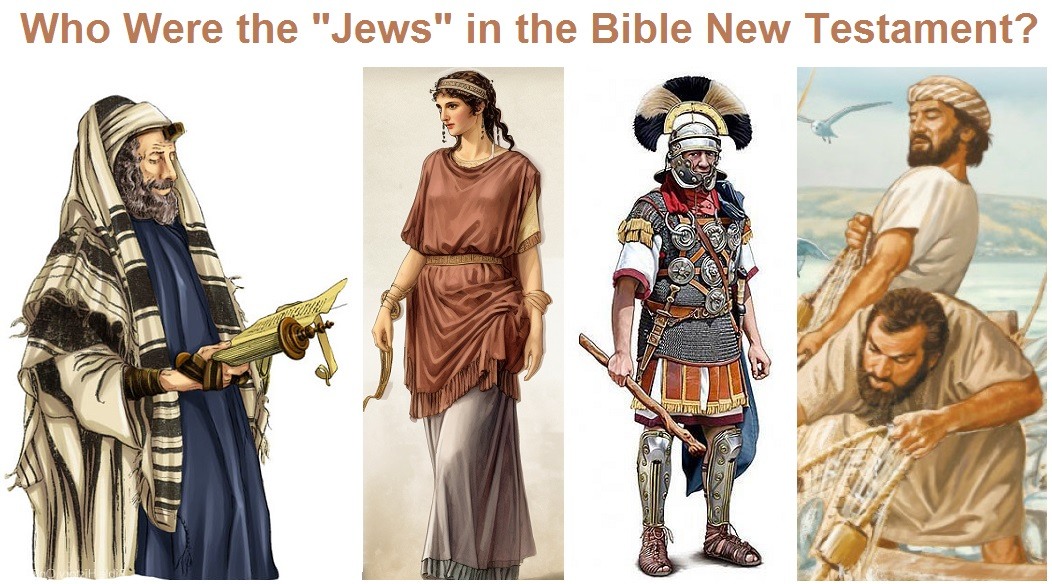
Left to Right Images: A Pharisee Jew (two are mentioned in the Gospels as secret followers of Christ, and the apostle Paul was a Pharisee Jew), a Roman woman such as Lydia in Acts 16 who was a business owner and ran her own synagogue, a Roman Centurion (at least two Centurion military leaders appear in the Gospel accounts encountering Jesus, and one is named in Acts 10), and Galilean Jewish fishermen (at least four of whom were among Jesus’s disciples).
by Brian Shilhavy
While the question of “who are the Jews” might seem like a purely religious topic that has no significance in a person’s daily life, especially if one does not consider themselves “religious”, the fact is that this topic affects everyone alive today, whether they are “religious” or not.
Today wars are being fought around the world and millions of people are being murdered because of the way certain people define who the Jews are.
And just for the record, I will restate what I have previously published many times in the past, which is that I am not a Christian, and I do not belong to any religious group at all.
In June of 2021, I wrote and published my first deep dive into this question of “who are the Jews”, and that article is probably a good place to start in understanding this topic. See:
Identifying the Luciferian Globalists Implementing the New World Order – Who are the “Jews”?
This article will provide supplementary information on the topic that was not included in that first article, which, as I wrote back then, was merely an “Introduction” to this topic, as it is a very exhaustive topic that too many people and too many groups try to simplify down into their own biases, for their own purposes and agendas.
My only “agenda” here, since I am not a member of any of these religious groups and have no “skin in the game”, is to simply expose the Truth, and accurately represent what the Bible really says on this topic.
This article is based on the book of Acts in the New Testament portion of the Bible, which I have been studying for the past few weeks. Acts traces the history of the Jewish believers just after the death and resurrection of Jesus Christ, and teaches us so much about who the true “believers” were, and how the term “Jew” was understood, both positively and negatively.
Once you understand these truths which are so clearly defined in the New Testament, you will be able to see what the true essence is of “the Gospel,” the “Good News”, which Peter, himself an ethnic Jew, a devout religious Jew, and one of the key leaders of the new movement in Jerusalem referred to as a “sect” of the Jewish faith called “The Way”, stated:
“I now realize how true it is that God does not show favoritism but accepts men from every nation who fear him and do what is right.” (Acts 10:34-35)
The Jews in Acts: “Devout Men from Every Nation Under Heaven”

Pentecostés by Juan Bautista Maíno (1581–1649). Source.
The history of the movement of the Jewish believers in Jesus Christ that started in Jerusalem mainly starts in Acts chapter 2, which records the event of the outpouring of the Holy Spirit which Jesus had foretold, which happened on the Jewish day of Pentecost.
When the day of Pentecost had come, they were all together in one place. And suddenly a noise like a violent rushing wind came from heaven, and it filled the whole house where they were sitting.
And tongues that looked like fire appeared to them, distributing themselves, and a tongue rested on each one of them. And they were all filled with the Holy Spirit and began to speak with different tongues, as the Spirit was giving them the ability to speak out.
Now there were staying in Jerusalem devout Jews from every nation under heaven.
And when this sound occurred, the crowd came together and they were bewildered, because each one of them was hearing them speak in his own language.
They were amazed and astonished, saying,
“Why, are not all these who are speaking Galileans? And how is it that we each hear them in our own language to which we were born?
Parthians, Medes, and Elamites, and residents of Mesopotamia, Judea, and Cappadocia, Pontus and Asia, Phrygia and Pamphylia, Egypt and the parts of Libya around Cyrene, and visitors from Rome, both Jews and proselytes, Cretans and Arabs—we hear them speaking in our own tongues of the mighty deeds of God.”
(Acts 2:1-5)
I have made bold some of the key words in this account of what happened in Jerusalem on that day. Right away, we can see that there were more than just ethnic Jews living in Jerusalem at that time. The English word “nation” in the Greek is ̓́ἔθνος- ethnos, from which we get certain English words such as “ethnic” and “ethnicity.”
So the fact is that all of the people in Acts 2 who received the outpouring of the Holy Spirit, were not all ethnic Jews. In fact, Luke, the author of Acts, writes that they were “from every nation (or ethnic group) under heaven.”
And yet, in total they were all referred to as “Jews”, but with an important adjective to describe what kind of Jews: devout Jews.
The use of the term “devout” Jews shows that there must also have been Jews who were not devout, otherwise the adjective is meaningless, because ethnic Jews are still ethnic Jews whether they are devout or not.
It seems quite clear that this was referring to their practice of the Jewish religion, the Law of Moses.
Luke goes on in Acts 2 to list where some of these devout Jews were from, which would have defined their ethnicity and the mother tongue that they spoke:
Parthians, Medes, and Elamites, and residents of Mesopotamia, Judea, and Cappadocia, Pontus and Asia, Phrygia and Pamphylia, Egypt and the parts of Libya around Cyrene, and visitors from Rome, both Jews and proselytes, Cretans and Arabs—we hear them speaking in our own tongues…
Luke also introduces another word in Acts 2 that described some of these devout Jews: “proselytes.” The Greek word is προσήλυτος prosēlutos. Here is how Thayer’s Greek Definitions defines this word:
Thayer Definition:
1) a newcomer
1a) a stranger, alien
2) a proselyte
2a) one who has come over from a Gentile religion to Judaism
We can conclude, therefore, that among the “devout Jews” living in Jerusalem at that time who were not ethnic Jews, that most of them were probably born into families who practiced the Jewish religion, even though they were not from Israel and did not, therefore, speak Aramaic, the language that was spoken in Israel during those days which was a mixed language of Hebrew and the Babylonian/Persian language.
The proselytes were born into a different religion, usually referred to as “paganism” which referred to the polytheistic religions of the Roman Empire at that time.
The religious Jews from outside Israel would have all been circumcised 8 days after birth according to the Law of Moses, while the proselytes were circumcised at the time of their conversion to Judaism.
The other men who were in Jerusalem on that day were the Galilean Jews who followed Jesus, and they were both ethnic Jews and religious Jews from the region of Galilee, where much of Jesus’s teaching and ministry happened.
But according to Luke, they were all “devout Jews”.
And in spite of their cultural and linguistic difference, on that day they all heard the Galilean Jews who were Jesus’s disciples, speak to them in their own native language supernaturally.
In my opinion, this was a reverse of the curse of the Tower of Babel in Genesis chapter 11:
Now the whole world had one language and a common speech.
As men moved eastward, they found a plain in Shinar and settled there. They said to each other,
“Come, let’s make bricks and bake them thoroughly.”
They used brick instead of stone, and tar for mortar. Then they said,
“Come, let us build ourselves a city, with a tower that reaches to the heavens, so that we may make a name for ourselves and not be scattered over the face of the whole earth.”
But the LORD came down to see the city and the tower that the men were building. The LORD said,
“If as one people speaking the same language they have begun to do this, then nothing they plan to do will be impossible for them. Come, let us go down and confuse their language so they will not understand each other.”
So the LORD scattered them from there over all the earth, and they stopped building the city.
That is why it was called Babel—because there the LORD confused the language of the whole world. From there the LORD scattered them over the face of the whole earth. (Genesis 11:1-9)
In Acts chapter 2 the exact opposite happened. Men from all over the world speaking different languages came to one place, Jerusalem, and they supernaturally were able to communicate with each other.
In modern day terms, I refer to this as the “Human Superior Intelligence” (HSI) network.
The Myth of a “Pure” Jewish Race
The facts from this historical event in Jerusalem on the Day of Pentecost completely contradict how most people today use the term “Jew”.
Today, many Christians, especially Evangelical Christians, believe in a pure Jewish race whose people are superior to other ethnic races.
However, the historical facts prove otherwise.
First, by the time Moses arrived on the scene and began the process of leading the Jews out of Egypt to become their own geo-political nation in the “Promised Land” as the nation of “Israel”, the Jews were already a mixed race of mostly Hebrews and Egyptians.
The word “Jew” itself is taken from one of the 12 sons of Jacob, who was renamed to “Israel,” and that son was Judah. Judah became one of the “12 tribes of Israel”, and Jesus was born as a descendant of Judah.
Therefore Abraham, the patriarch of the Jewish people, was not even Jewish himself, but a Hebrew.
One of Jacob’s other sons, Joseph, was sold into captivity by the other 11 brothers, and ended up the ruler of Egypt, and had an Egyptian wife, not a Hebrew wife.
Joseph had two sons by his Egyptian wife, Manasseh and Ephraim, who became part of the “tribes of Israel.”
So they were at least half Egyptian by ethnicity, but potentially even a lot more than half, because the Jews lived in Egypt for over 400 years, and it is likely that Joseph’s sons, and probably many other Jews, inter-married with the ethnic Egyptians in whose country they were living in.
By the time the age of the Kings began in Israel, we see the Kings of Israel also taking many non-Jewish wives. King Solomon had a total of 1000 wives! And most of them were not Jews.
King Solomon, however, loved many foreign women besides Pharaoh’s daughter—Moabites, Ammonites, Edomites, Sidonians and Hittites. They were from nations about which the LORD had told the Israelites,
“You must not intermarry with them, because they will surely turn your hearts after their gods.”
Nevertheless, Solomon held fast to them in love. He had seven hundred wives of royal birth and three hundred concubines, and his wives led him astray. (1 Kings 11:1-3)
Many of the Jews living in Israel today are Ashkenazi Jews from Europe, and have no actual ancestry back to Abraham at all. They were originally Jewish converts, or originally “proselytes.”
A “pure” Jewish race is nothing more than a myth to support an agenda, an agenda that believes they are more privileged than any other race of people, which is used as an excuse to commit acts of genocide against the “goyim” or the worthless human beings who do not deserve to live.
The people living in Israel today who have the closest ethnic ties to the people who lived in Israel in the First Century when Jesus walked the earth, are the Palestinians.
These natives were originally Jews by religion, then many of them became Christians around the 4th Century, and then many of them became Muslims around the 7th Century after the start of Islam.
Today in Palestine, you still find people of all three religions: Jews, Christians, and Muslims.
Clash of the Israeli Jews with the Roman Jews in Acts
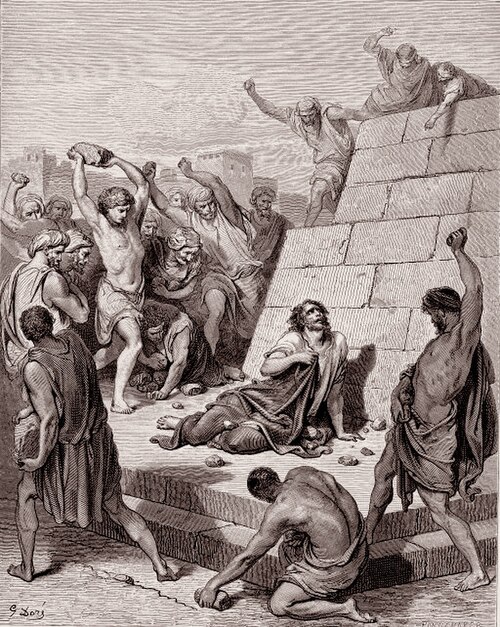
Martydom of Stephen. Acts 7:59-60. Illustration by Gustave Doré. 1890. Source.
In Acts chapter 6, we see one of the first major conflicts arise among the Jews who were born outside of Israel living in Jerusalem with the Jews born in Israel.
Now at this time, as the disciples were increasing in number, a complaint developed on the part of the Hellenistic Jews against the native Hebrews, because their widows were being overlooked in the daily serving of food. (Acts 6:1 NASB)
This first verse of the chapter is interesting, because the English translators had a hard time translating it, as is evidenced by the various English translations we have today describing the two groups in this verse. The word “Jew” does not, in fact, even appear in this verse at all in the original Greek.
Here are some other English translations of this verse besides the one I just quoted above, the New American Standard Bible (NASB).
And in those days, when the number of the disciples was multiplied, there arose a murmuring of the Grecians against the Hebrews, because their widows were neglected in the daily ministration. (Acts 6:1 KJV)
In those days when the number of disciples was increasing, the Grecian Jews among them complained against the Hebraic Jews because their widows were being overlooked in the daily distribution of food.
(Acts 6:1 NIV84)
Now in these days when the disciples were increasing in number, a complaint by the Hellenists arose against the Hebrews because their widows were being neglected in the daily distribution. (Acts 6:1 ESV)
The story continues in Acts 6:
So the twelve summoned the congregation of the disciples and said,
“It is not desirable for us to neglect the word of God in order to serve tables. Instead, brothers and sisters, select from among you seven men of good reputation, full of the Spirit and of wisdom, whom we may put in charge of this task. But we will devote ourselves to prayer and to the ministry of the word.”
The announcement found approval with the whole congregation; and they chose Stephen, a man full of faith and of the Holy Spirit, and Philip, Prochorus, Nicanor, Timon, Parmenas, and Nicolas, a proselyte from Antioch.
(Acts 6:2-5)
There are several things to observe in these verses that most Christian teachers or pastors will probably never acknowledge.
First, there are NO CHRISTIANS in this chapter! And yet every single English commentary I have ever read on the book of Acts will continually refer to the believers in these early chapters of Acts as “Christians.”
The textual evidence itself refutes this Christian bias. The word “Christian” is only used three times in the entire New Testament, two of them in the book of Acts.
The first occurrence of the word “Christian” happens much later in the book, in Acts chapter 11:
The disciples were called Christians first at Antioch. (Acts 11:26)
Notice how the main term used of the Jewish believers in Jesus is the term “disciple”, specifically a “disciple of Jesus Christ.” Jesus was also continually referred to as “Rabbi”, a name used for a Jewish leader and teacher.
It is also seen in Acts 11 that the term “Christian” was used by those outside of the congregation of disciples, and it specifically referred to the Gentile believers who were in Antioch, not the Jewish ones.
Now those who had been scattered by the persecution in connection with Stephen traveled as far as Phoenicia, Cyprus and Antioch, telling the message only to Jews.
Some of them, however, men from Cyprus and Cyrene, went to Antioch and began to speak to Greeks also, telling them the good news about the Lord Jesus. (Acts 11:19-20)
So there were no Christians in Acts chapter 6. They were all Jews, but they were not all ethnic Jews, as the entire list of disciples who were chosen for the distribution of food had Greek names, not Hebrew names.
So they were Roman Jews, with one exception: Nicolas, a proselyte from Antioch.
Nicolas was not born into the Jewish faith, and had to convert from the polytheistic Greek/Roman religions. I will write more about Nicolas below.
Back to Acts chapter 6:
Now Stephen, a man full of God’s grace and power, did great wonders and miraculous signs among the people. Opposition arose, however, from members of the Synagogue of the Freedmen (as it was called)—Jews of Cyrene and Alexandria as well as the provinces of Cilicia and Asia.
These men began to argue with Stephen, but they could not stand up against his wisdom or the Spirit by whom he spoke.
Then they secretly persuaded some men to say,
“We have heard Stephen speak words of blasphemy against Moses and against God.”
So they stirred up the people and the elders and the teachers of the law. They seized Stephen and brought him before the Sanhedrin.
They produced false witnesses, who testified,
“This fellow never stops speaking against this holy place and against the law. For we have heard him say that this Jesus of Nazareth will destroy this place and change the customs Moses handed down to us.”
(Acts 6:8-14)
The “Synagogue of the Freedmen” referred to here, is believed by some historians to refer to a group of Roman soldiers who were imprisoned, and then upon their release from prison became Jewish converts. Most of the early Christian writers did not like this possibility, because it did not fit their narrative as to who were “Jews” and who were “Christians.”
It is obvious from the beginning of this chapter in Acts, that there was constant friction between the Jews living in Israel, and the Jews living scattered among the Roman Empire outside of Israel, who could not even speak the native language of the Judeans.
The Jews who were disciples of Jesus, were referred to as belonging to “The Way”. They were Jews, not Christians, as they were considered a sect of the Jewish religion. See:
Hodos: The Way of Christ – One Way Only, No U-Turns
To be both an ethnic Jew and a “devout” Jew who followed the Jewish religion, and then to be called a “Christian,” would have been an insult, since the term only applied to pagans who converted to Judaism and then embraced Christ, the Messiah.
This is clearly seen in the second time the word “Christian” is used in Acts, in chapter 26:
Then Agrippa said to Paul,
“Do you think that in such a short time you can persuade me to be a Christian?”
Paul replied,
“Short time or long—I pray God that not only you but all who are listening to me today may become what I am, except for these chains.”
(Acts 26:28-29)
Notice how Paul answered the Jewish King’s question. He did not say “Yes, I wish you would become a Christian.”
Paul was a strict Jew, and even kept obeying certain parts of the Jewish religion after he became a disciple of Jesus. King Agrippa was of Edomite descent, and considered an Idumean by many in Israel, and not a true “Jew”.
So to convert to a “Christian” which meant a pagan who converted to Judaism as a proselyte and then embraced Christ, would have been an insult.
Paul then answered: I pray God that not only you but all who are listening to me today may become what I am, except for these chains. What Paul was, was a Roman Jew who became a disciple of Jesus Christ, but never a Christian.
And yet at the same time, he obviously did not want to throw the Christians under the bus, because most of them were a result of his ministry, because he spent so much time in Antioch.
There is never a single person named in the Bible as a “Christian.” However, there is one group of Christians that are mentioned, and Jesus said he literally “hated” them, the Nicolaitans, who were a group probably started by Nicolas of Antioch of Acts 6, who left The Way. See:
The Demonic Roots of Christianity: The Christians Jesus Said He Hated
The native Jews who began putting their faith in Jesus as the Jewish Messiah, at least intellectually, were very stubborn when it came to obeying the Law of Moses and everything in the Old Covenant. It was a sense of pride, and even “nationalism” which was demonic, not Godly.
To show how difficult it was to get a native Jew to repent of his national pride, and his prejudice against those who were not born into the Jewish faith, we have the story of Peter in Acts chapter 10.
As you read this story, notice the great lengths that God had to go through to get Peter to repent of his evil Jewish beliefs, which were probably based on the “traditions of the elders”, and not the actual Law of Moses.
At Caesarea there was a man named Cornelius, a centurion in what was known as the Italian Regiment.
He and all his family were devout and God-fearing; he gave generously to those in need and prayed to God regularly.
One day at about three in the afternoon he had a vision. He distinctly saw an angel of God, who came to him and said,
“Cornelius!”
Cornelius stared at him in fear.
“What is it, Lord?” he asked.
The angel answered,
“Your prayers and gifts to the poor have come up as a memorial offering before God. Now send men to Joppa to bring back a man named Simon who is called Peter. He is staying with Simon the tanner, whose house is by the sea.”
When the angel who spoke to him had gone, Cornelius called two of his servants and a devout soldier who was one of his attendants. He told them everything that had happened and sent them to Joppa.
About noon the following day as they were on their journey and approaching the city, Peter went up on the roof to pray.
He became hungry and wanted something to eat, and while the meal was being prepared, he fell into a trance. He saw heaven opened and something like a large sheet being let down to earth by its four corners.
It contained all kinds of four-footed animals, as well as reptiles of the earth and birds of the air. Then a voice told him,
“Get up, Peter. Kill and eat.”
“Surely not, Lord!” Peter replied.
“I have never eaten anything impure or unclean.”
The voice spoke to him a second time,
“Do not call anything impure that God has made clean.”
This happened three times, and immediately the sheet was taken back to heaven.
While Peter was wondering about the meaning of the vision, the men sent by Cornelius found out where Simon’s house was and stopped at the gate. They called out, asking if Simon who was known as Peter was staying there.
While Peter was still thinking about the vision, the Spirit said to him,
“Simon, three men are looking for you. So get up and go downstairs. Do not hesitate to go with them, for I have sent them.”
Peter went down and said to the men,
“I’m the one you’re looking for. Why have you come?”
The men replied,
“We have come from Cornelius the centurion. He is a righteous and God-fearing man, who is respected by all the Jewish people. A holy angel told him to have you come to his house so that he could hear what you have to say.”
Then Peter invited the men into the house to be his guests. The next day Peter started out with them, and some of the brothers from Joppa went along.
The following day he arrived in Caesarea. Cornelius was expecting them and had called together his relatives and close friends.
As Peter entered the house, Cornelius met him and fell at his feet in reverence. But Peter made him get up. “Stand up,” he said, “I am only a man myself.”
Talking with him, Peter went inside and found a large gathering of people. He said to them:
“You are well aware that it is against our law for a Jew to associate with a Gentile or visit him. But God has shown me that I should not call any man impure or unclean. So when I was sent for, I came without raising any objection. May I ask why you sent for me?”
Cornelius answered:
“Four days ago I was in my house praying at this hour, at three in the afternoon. Suddenly a man in shining clothes stood before me and said, ‘Cornelius, God has heard your prayer and remembered your gifts to the poor. Send to Joppa for Simon who is called Peter. He is a guest in the home of Simon the tanner, who lives by the sea.’
So I sent for you immediately, and it was good of you to come. Now we are all here in the presence of God to listen to everything the Lord has commanded you to tell us.”
Then Peter began to speak:
“I now realize how true it is that God does not show favoritism but accepts men from every nation who fear him and do what is right.”
(Acts 10:1-35)
When Peter said: “You are well aware that it is against our law for a Jew to associate with a Gentile or visit him“, he was NOT talking about the Law of Moses and the Old Testament portion of the Bible, because while the Old Testament Law does regulate certain actions between Jews and Gentiles, forbidding them to even have contact with each other like that is not in the Old Testament Law, but were among all the additional “laws” added by the Jews and referred to in the New Testament as the “traditions of the elders.”
In fact, Jesus himself, if Peter had but remembered, was invited to the house of a Centurion believer, and was on his way to visit him.
When Jesus had entered Capernaum, a centurion came to him, asking for help.
“Lord,” he said, “my servant lies at home paralyzed and in terrible suffering.”
Jesus said to him,
“I will go and heal him.”
The centurion replied,
“Lord, I do not deserve to have you come under my roof. But just say the word, and my servant will be healed. For I myself am a man under authority, with soldiers under me.
I tell this one, ‘Go,’ and he goes; and that one, ‘Come,’ and he comes. I say to my servant, ‘Do this,’ and he does it.”
When Jesus heard this, he was astonished and said to those following him,
“I tell you the truth, I have not found anyone in Israel with such great faith. I say to you that many will come from the east and the west, and will take their places at the feast with Abraham, Isaac and Jacob in the kingdom of heaven.
But the subjects of the kingdom will be thrown outside, into the darkness, where there will be weeping and gnashing of teeth.”
Then Jesus said to the centurion,
“Go! It will be done just as you believed it would.”
And his servant was healed at that very hour. (Matthew 8:5-13)
Sadly, even after this event with the Roman Centurion in Acts 10, Peter still fell back into his old ways and started looking down on the Gentile believers again, until he was rebuked by Paul, a Roman Jew:
When Peter came to Antioch, I opposed him to his face, because he was clearly in the wrong. Before certain men came from James, he used to eat with the Gentiles.
But when they arrived, he began to draw back and separate himself from the Gentiles because he was afraid of those who belonged to the circumcision group.
The other Jews joined him in his hypocrisy, so that by their hypocrisy even Barnabas was led astray.
When I saw that they were not acting in line with the truth of the gospel, I said to Peter in front of them all,
“You are a Jew, yet you live like a Gentile and not like a Jew. How is it, then, that you force Gentiles to follow Jewish customs?”
(Galatians 2:11-14)
The True Jews are the Believers who are Disciples of Jesus Christ
I am still just barely scratching the surface on this very divisive topic of who are the Jews, but in summary we can conclude that the true Jews in the Bible are the ones who have become disciples of Jesus Christ, regardless of ethnicity or religious affiliations.
This is what Jesus said about the “Jews” in the last book of the Bible, the book of Revelation:
I know your afflictions and your poverty—yet you are rich! I know the slander of those who say they are Jews and are not, but are a synagogue of Satan. (Revelation 2:9)
I will make those who are of the synagogue of Satan, who claim to be Jews though they are not, but are liars—I will make them come and fall down at your feet and acknowledge that I have loved you. (Revelation 3:9)
Jesus is very clearly using the term “Jew” to refer to a believer who is one of his disciples.
As to the ethnic Jews, Jesus also addressed them in John chapter 8, distinguishing between the Jews who believed in him, and the Jews who were of their father the Devil.
To the Jews who had believed him, Jesus said,
“If you hold to my teaching, you are really my disciples. Then you will know the truth, and the truth will set you free.”
To the ethnic Jews who did not believe in him:
Jesus said to them,
“If God were your Father, you would love me, for I came from God and now am here. I have not come on my own; but he sent me. Why is my language not clear to you? Because you are unable to hear what I say.
You belong to your father, the devil, and you want to carry out your father’s desire. He was a murderer from the beginning, not holding to the truth, for there is no truth in him.
When he lies, he speaks his native language, for he is a liar and the father of lies.
(John 8:42-44)
The true Gospel message is being perverted and twisted into a message of embracing the Jewish people in the Middle East today as a chosen, special group of people, and this Satanic belief system is mainly being espoused by American Evangelical Christians in the current Trump Administration.
It is time for the true Jews, the believers in Jesus Christ, to expose this horrible evil being taught all across the United States in American Conservative Christian churches.
Related:
Leave a Reply