





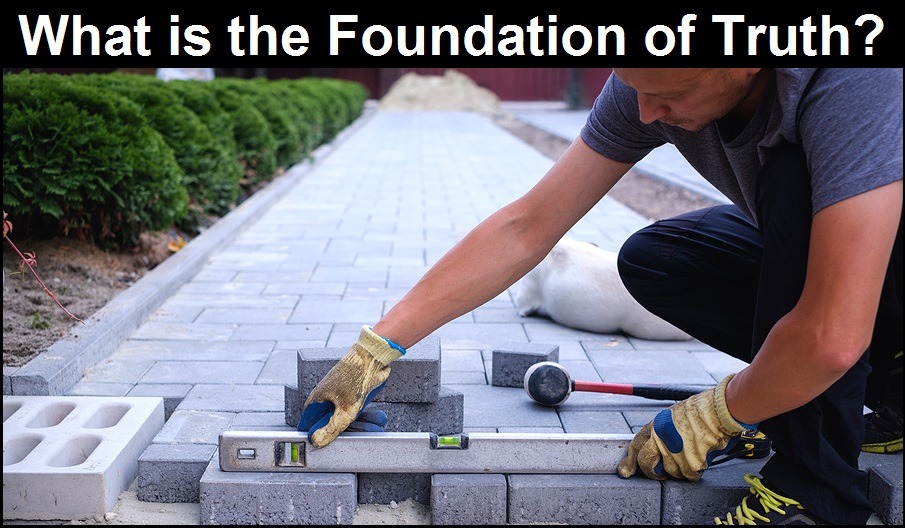
For no one can lay any foundation other than the one already laid, which is Jesus Christ. (1 Corinthians 3:11)
by Brian Shilhavy
In Paul’s first letter to his young disciple, Timothy, which is recorded in the New Testament portion of the Bible, he writes:
Although I hope to come to you soon, I am writing you these instructions so that, if I am delayed, you will know how people ought to conduct themselves in God’s household, which is the assembly of the living God, the pillar and foundation of the truth. (1 Timothy 3:14-15)
So what is the “pillar and foundation of the truth” that he writes about here?
Well first of all, I can conclusively say that what he is NOT referring to here is “the Church,” which is what almost all Christians are taught in regards to this verse.
The verse actually defines what the “pillar and foundation of the truth” is, which is “God’s household.”
Fortunately, we have many other teachings in the New Testament that define what “God’s household” is, and it is NOT “the Church”, as most Western Christians are taught to falsely believe today.
The Word “Church” Should Not be in the English Translations of the Bible
I have dealt with the incorrect English translation of the Greek word ἐκκλησία (ekklēsia) that James Charles Stuart, the King of England in 1611, “authorized” in his government-approved English translation of the Greek Bible. See:
Should You Read the Ancient Bible? Is The Bible Accurate or Corrupted?
Excerpt:
The English word “church” is used to translate the Greek word ekklesia. But ekklesia means “assembly,” or “congregation.”
The English word “church,” if you study its etymology (history of use) comes originally from the Greek word “kurios” which means “Lord.”
It is an improper word to use in translation of “ekklesia.” In the Roman world of New Testament times, ekklesia was used for general assemblies, and not necessarily religious assemblies.
It is the word used in Acts 19:32, 39, 41 where it is translated “assembly” because there is no “church” here. It was an assembly, an unruly mob actually, gathered together to try and kill Paul.
Wycliff is credited with first using the word “church” as a translation not of the Greek text, but from the Latin Vulgate used in the Catholic Church.
Another translator who did translate into English from the Greek and Hebrew texts, was William Tyndale in the early 1500s.
He rejected the word “church” for ekklesia and used “congregation” instead because:
Of grievous concern to Tyndale was the misuse of ill-gotten wealth by clergy, monks, and prelates (whom Tyndale often called the ‘spirituality,’ as here):
“What good conscience can there be among our spirituality to gather so great treasure together, and with hypocrisy of their false learning to rob almost every man of house and lands … seeking in Christ nothing but lucre?”
Tyndale said the monks and clergy crept into people’s consciences, robbed them of the faith of Christ, and caused them to give their money to build new churches and cloisters through a false faith in such works, by which all suffered:
“… the building of [churches and steeples] and such like, through the false faith that we have in them, is the decay of all the havens in England, and of all the cities, towns, highways, and shortly, of the whole commonwealth.
For since these false monsters crept up into our consciences, and robbed us of the knowledge of our Saviour Christ, making us believe in such pope-holy works, and to think that there was none other way unto heaven, we have not ceased to build them abbeys, cloisters, colleges, chauntries, and cathedral churches with high steeples, striving and envying one another, who should do most.”
Therefore, by using ‘congregation’ in his New Testament, Tyndale was both being faithful to the Greek and avoiding a usage that would contribute to the continuing exploitation or deception of the people.
Indeed this, Tyndale’s translation, together with his books and writings, have led some to credit him with “breaking the spell attached to the word church,” and “breaking the suffocating power of the medieval church.” (Source.)
However, just to make a point, Tyndale did use the English word “church” in one place: Acts 19 and the secular mob assembly, which I quoted above. He used it in verse 37:
You have brought these men here, though they have neither robbed temples nor blasphemed our goddess. (Acts 19:37)
The Greek word for “robbed temples” is hierosulos, and Tyndale translated it as “robbed churches.”
The King of England presiding over the Church of England and the Pope presiding over the Catholic Church were not amused.
Tyndale was considered a heretic and eventually was burned at the stake. (Full article.)
In the verse I quoted above in 1 Timothy 3:15: “…which is the assembly of the living God, the pillar and foundation of the truth“, I intentionally chose a translation that correctly translated ekklesia as “assembly” (a word very similar to “congregation”), but probably 99.99% of the English translations available today continue to use the wrong word “church” here.
Why?
Because the major publishing houses of copyrighted English Bibles today sell their Bibles mainly to, you probably already guessed it by now, churches and the tens of millions of “professional Christians” (pastors, priests, bishops, etc.) leading these churches who use these English Bibles in their “churches” to justify continuing to make money by being a professional Christian.
The World English Bible (open source free bible), and the older Young’s Living Translation (YLT) are two of the minority English translations that use the proper “assembly” instead to translate ekklesia.
One of the Latin languages, Spanish, uses the more appropriate “iglesia” instead of “church” (although in practice there is little difference.)
Y si no fuere tan presto, para que sepas cómo te conviene conversar en la casa de Dios, que es la iglesia del Dios vivo, columna y apoyo de la verdad. (1 Timothy 3:15)
Fortunately, as I wrote above, Paul defines what the “pillar and foundation of the truth” is by calling it the “household of God.”
So what is the “household of God”?
It is NOT a physical structure, but a spiritual one.
But rather than me trying to explain to you what it is, I am just going to quote other New Testament Bible verses that already explain what this “household of God” is as the “pillar and foundation of the truth”.
Consequently, you are no longer foreigners and aliens, but fellow citizens with God’s people and members of God’s household, built on the foundation of the apostles and prophets, with Christ Jesus himself as the chief cornerstone.
In him the whole building is joined together and rises to become a holy temple in the Lord. And in him you too are being built together to become a dwelling in which God lives by his Spirit. (Ephesians 2:19-22)
As you come to him, the living Stone—rejected by men but chosen by God and precious to him—you also, like living stones, are being built into a spiritual house to be a holy priesthood, offering spiritual sacrifices acceptable to God through Jesus Christ.
For in Scripture it says: “See, I lay a stone in Zion, a chosen and precious cornerstone, and the one who trusts in him will never be put to shame.” (1 Peter 2:4-6)
He was faithful to the one who appointed him, just as Moses was faithful in all God’s house.
Jesus has been found worthy of greater honor than Moses, just as the builder of a house has greater honor than the house itself.
For every house is built by someone, but God is the builder of everything.
Moses was faithful as a servant in all God’s house, testifying to what would be said in the future.
But Christ is faithful as a son over God’s house.
And we are his house, if we hold on to our courage and the hope of which we boast. (Hebrews 3:2-6)
Here are some other verses in the New Testament on the “Foundation of Truth” which is also the “Foundation of Christ“, because Jesus said: “I am the way and the truth and the life. No one comes to the Father except through me.” (John 14:6)
“Why do you call me, ‘Lord, Lord,’ and do not do what I say?
I will show you what he is like who comes to me and hears my words and puts them into practice. He is like a man building a house, who dug down deep and laid the foundation on rock.
When a flood came, the torrent struck that house but could not shake it, because it was well built.
But the one who hears my words and does not put them into practice is like a man who built a house on the ground without a foundation.
The moment the torrent struck that house, it collapsed and its destruction was complete.” (Luke 6:46-49)
By the grace God has given me, I laid a foundation as an expert builder, and someone else is building on it.
But each one should be careful how he builds.
For no one can lay any foundation other than the one already laid, which is Jesus Christ.
If any man builds on this foundation using gold, silver, costly stones, wood, hay or straw, his work will be shown for what it is, because the Day will bring it to light.
It will be revealed with fire, and the fire will test the quality of each man’s work.
If what he has built survives, he will receive his reward. If it is burned up, he will suffer loss; he himself will be saved, but only as one escaping through the flames.
Don’t you know that you yourselves are God’s temple and that God’s Spirit lives in you?
If anyone destroys God’s temple, God will destroy him; for God’s temple is sacred, and you are that temple.
Do not deceive yourselves. If any one of you thinks he is wise by the standards of this age, he should become a “fool” so that he may become wise.
For the wisdom of this world is foolishness in God’s sight.
As it is written: “He catches the wise in their craftiness“; and again, “The Lord knows that the thoughts of the wise are futile.” (1 Corinthians 3:10-20)
The pillar and foundation of the truth that Paul wrote about in 1 Timothy 3:15 is NOT the American Christian Church, no matter what flavor of Christianity it is (Catholic, Protestant, Evangelical, Mormon, etc.).
The pillar and foundation of the truth that Paul wrote about is Jesus Christ, and his congregation/assembly who represents him here on earth in Satan’s world system.
We are the minority who goes against the crowd, and travels down the more difficult path least traveled, which leads to persecution and suffering.
“Enter through the narrow gate. For wide is the gate and broad is the road that leads to destruction, and many enter through it. But small is the gate and narrow the road that leads to life, and only a few find it.” (Matthew 7:13-14)
See Also:
Trials and Persecution of Believers: “We were Destined for Them”
Wake up sons and daughters of God! The darkness is increasing, and now is our time to shine our light into this dark, evil world, as we are the Pillar and Foundation of the Truth, and we must expose the false believers, even if they are in our own family, business, or “church”.
Because if we do not take our stand for Jesus, and the Truth, nobody else will.
Then he called the crowd to him along with his disciples and said:
“If anyone would come after me, he must deny himself and take up his cross and follow me.
For whoever wants to save his life will lose it, but whoever loses his life for me and for the gospel will save it.
What good is it for a man to gain the whole world, yet forfeit his soul? Or what can a man give in exchange for his soul?
If anyone is ashamed of me and my words in this adulterous and sinful generation, the Son of Man will be ashamed of him when he comes in his Father’s glory with the holy angels.” (Mark 8:34-38)
5 Comments