





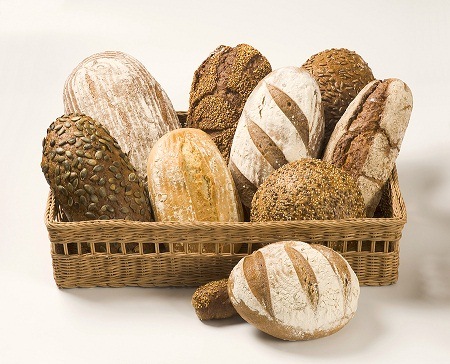
Give us today our daily bread. (Mat 6:11)
These famous words are recorded in what is known as “The Lord’s Prayer” and are part of a “model prayer” that Jesus gave to his disciples instructing them how to pray. “Bread” in the Bible and in the Middle East represented life itself, as grains used to make bread were the staple food. Therefore the meaning of “bread” in this verse represents all food needed daily to sustain us. When we pray this prayer, we are acknowledging that all sustenance comes from God, and that we are dependent upon him to give it to us every day.
We have established the fact in other devotionals that all food comes from God. All food originates from reproducing plant life – life that God created. It takes water, air and sunlight for plants to grow, elements that God also created and regulates. The animals that become meat for our food are dependent on this same plant life, air, water, and sunlight.
The Hebrews had a much more spiritual understanding of food than we have today in western culture, where a Darwinian evolutionary foundation of knowledge clouds our understanding. Much of the basis of the Biblical understanding of food came from the Jew’s experience of living in the desert for 40 years after they left Egypt. They lived in a barren place that produced very little food. During those years God supernaturally supplied them with a food from heaven called “manna.” The story is recorded in Exodus chapter 16:
In the desert the whole community grumbled against Moses and Aaron. The Israelites said to them, “If only we had died by the LORD’s hand in Egypt! There we sat around pots of meat and ate all the food we wanted, but you have brought us out into this desert to starve this entire assembly to death.”
Then the LORD said to Moses, “I will rain down bread from heaven for you. The people are to go out each day and gather enough for that day. In this way I will test them and see whether they will follow my instructions. On the sixth day they are to prepare what they bring in, and that is to be twice as much as they gather on the other days.”
So Moses and Aaron said to all the Israelites, “In the evening you will know that it was the LORD who brought you out of Egypt, and in the morning you will see the glory of the LORD, because he has heard your grumbling against him. Who are we, that you should grumble against us?” Moses also said, “You will know that it was the LORD when he gives you meat to eat in the evening and all the bread you want in the morning, because he has heard your grumbling against him…”
The LORD said to Moses, “I have heard the grumbling of the Israelites. Tell them, ‘At twilight you will eat meat, and in the morning you will be filled with bread. Then you will know that I am the LORD your God.'”
That evening quail came and covered the camp, and in the morning there was a layer of dew around the camp. When the dew was gone, thin flakes like frost on the ground appeared on the desert floor.
When the Israelites saw it, they said to each other, “What is it?” For they did not know what it was.
Moses said to them, “It is the bread the LORD has given you to eat. This is what the LORD has commanded: ‘Each one is to gather as much as he needs. Take an omer for each person you have in your tent.'”
The Israelites did as they were told; some gathered much, some little. And when they measured it by the omer, he who gathered much did not have too much, and he who gathered little did not have too little. Each one gathered as much as he needed. (Exodus 16:1-18)
This experience in the desert taught the people to trust in God for their “daily bread.” Interestingly, if people tried to hoard the manna and collect more than they needed and more than they were able to consume within that day, it rotted and became full of maggots:
Then Moses said to them, “No one is to keep any of it until morning.” However, some of them paid no attention to Moses; they kept part of it until morning, but it was full of maggots and began to smell. So Moses was angry with them. (Exodus 16:19-20)
There was one exception to this principle. On the sixth day of the week, they were told to collect twice as much, so that they would not have to collect any on the Sabbath, the seventh day of the week, because God was not going to give any manna on that day:
On the sixth day, they gathered twice as much—two omers for each person—and the leaders of the community came and reported this to Moses. He said to them, “This is what the LORD commanded: ‘Tomorrow is to be a day of rest, a holy Sabbath to the LORD. So bake what you want to bake and boil what you want to boil. Save whatever is left and keep it until morning.'”
So they saved it until morning, as Moses commanded, and it did not stink or get maggots in it. “Eat it today,” Moses said, “because today is a Sabbath to the LORD. You will not find any of it on the ground today. Six days you are to gather it, but on the seventh day, the Sabbath, there will not be any.” Nevertheless, some of the people went out on the seventh day to gather it, but they found none. (Exodus 16:22-27)
So the principles of relying on God for “daily bread,” which every Jew would have clearly understood when Jesus gave them these words in this prayer, if they had studied their historical heritage, could be summarized with these main points:
1. God supplies our food.
2. We are dependent upon God to supply it.
3. We are not supposed to hoard it.
4. There are times to collect more than we need for future use.
When the Hebrews finally left the desert and settled in the fertile “promised land,” described as a land flowing with “milk and honey,” they continued to follow these same principles, of depending upon God to supply them their “daily bread” by blessing the land where they were living. When the land failed to produce food, they turned to God to find the reason and to supply them with the need for “daily bread.” Their society was very connected to their food sources, and individual wealth was usually measured in terms of livestock and land owned.
Contrast this way of life with the way of life in the 21st century in western culture. When the United States was founded in 1776, about 90 percent of the population was involved in agriculture and producing food. By the time Abraham Lincoln became president in 1860, the percentage had dropped to about 50%. Today, many years after the “industrial revolution,” that number is less than 1%.
Most of our society is no longer connected to our food sources, and very few people would even understand the concept that we are dependent upon God to supply our food, our “daily bread.” With a Darwinian evolutionary understanding of science and technology, our culture has come to depend on a very few wealthy companies to control the bulk of our food system. The result of this concentrated power among such a small percentage of our population has been disastrous.
The results of mass-produced foods are less nutrient dense food, toxic food, destruction of natural resources, and poor health. Our poor health, both among the human population as well as the livestock population, has resulted in a very prosperous pharmaceutical industry which depends on our poor health to sell their products. We no longer depend upon God for our “daily bread,” and most of us are not even aware of what the problem is, let alone what the solutions are.
“Daily Bread” More than Just Food
Our need for “daily bread” is not restricted to the just the food we eat. Just as our physical bodies require physical food to survive, so our souls require daily spiritual food to survive. I have written about this in previous devotionals. (See: The Superiority of Spiritual Food and The Necessity of Spiritual Food) Jesus sums up what our daily spiritual bread needs are when he says “Man does not live on bread alone, but on every word that comes from the mouth of God.” (Matthew 4:4)
Do you recognize that you need to depend upon God for your “daily bread?” Do you go to him in prayer asking him to supply you with the healthy food your body requires? Do you trust the people who supply your food? Do you even know who they are? Do they trust God? What will happen if you go to the store one day and find that the shelves are bare because those you put your trust in to supply your food have failed? Is the food you are now buying even healthy, in the form God created it?
What about your daily need for spiritual food? God has uniquely created you as a very special person, and he has a plan and purpose for your life. Do you spend time with him each day to listen to what he has to say to you personally? Do you depend upon him for your daily needs? If we have any hope in western culture today in solving our massive food and health problems, we are going to need to return to our basic understanding that we depend upon God for our “daily bread.”
The fields are ruined, the ground is dried up; the grain is destroyed, the new wine is dried up, the oil fails. Despair, you farmers, wail, you vine growers; grieve for the wheat and the barley, because the harvest of the field is destroyed. The vine is dried up and the fig tree is withered; the pomegranate, the palm and the apple tree— all the trees of the field—are dried up. Surely the joy of mankind is withered away.
Has not the food been cut off before our very eyes— joy and gladness from the house of our God? The seeds are shriveled beneath the clods. The storehouses are in ruins, the granaries have been broken down, for the grain has dried up. How the cattle moan! The herds mill about because they have no pasture; even the flocks of sheep are suffering. To you, O LORD, I call, for fire has devoured the open pastures and flames have burned up all the trees of the field. Even the wild animals pant for you; the streams of water have dried up and fire has devoured the open pastures. (Joel 1:10-20)
Leave a Reply